

Finding the best guest bed for small spaces usually means making a compromise. You want visitors to have a proper place to sleep, but you may not have a spare bedroom or enough floor space to keep a permanent bed in place all year.
For flats, smaller houses and multi-purpose rooms, three options tend to make the most sense: airbeds, sofa beds and folding beds. Each can work well, but they solve the space problem in very different ways.
An airbed can disappear into storage when it is not needed. A sofa bed gives you permanent seating as well as somewhere to sleep. A folding bed provides a more conventional mattress but still needs somewhere substantial to live between visits.
So which is right for your home? This guide compares the three based on the things that matter most in a small space: sleeping comfort, storage, setup, floor space, flexibility and suitability for regular guests.
What Makes the Best Guest Bed for Small Spaces?
The smallest option is not automatically the most practical.
A guest bed needs to work in two different states: when somebody is sleeping on it and when nobody is using it.
Before choosing one, think about:
- Available floor space: Can you fit a full sleeping surface without blocking doors or walkways?
- Storage space: Where will the bed go for the other 350 nights of the year?
- Guest frequency: Are visitors staying twice a year or twice a month?
- Length of stay: A one-night sleepover creates different requirements from a week-long family visit.
- Guest age and mobility: Getting onto and off a very low sleeping surface may be less convenient for some adults.
- Setup time: Do you want something permanently ready or something you can prepare only when required?
- Room function: Does your office, living room or playroom need to return to normal immediately after guests leave?
The right answer is usually the option that causes the least disruption to everyday life while still giving guests a comfortable, practical place to sleep.
Airbed vs Sofa Bed vs Folding Bed: Quick Comparison
| Feature | Airbed | Sofa Bed | Folding Bed |
|---|---|---|---|
| Space needed when stored | Low | High, but doubles as seating | Medium to high |
| Floor space when in use | Similar to mattress size | Often substantial once opened | Similar to single-bed size |
| Easy to move between rooms | Yes | No | Sometimes |
| Quick to put away | Yes, after deflation | Usually | Usually |
| Permanent furniture required | No | Yes | No |
| Choice of sleeping sizes | Wide | Model dependent | Often more limited |
| Good for multi-purpose rooms | Excellent | Good if seating is also needed | Good if storage space is available |
| Main compromise | Needs inflation and suitable storage | Uses permanent floor space | Bulky when folded |
Option 1: Airbeds for Small Spaces
For homes where storage and flexibility are the biggest priorities, an airbed is one of the most practical guest-bed options.
It provides a full sleeping surface when needed but can be deflated and stored afterwards. That makes it especially useful when a room has another purpose during the day.
For example, an airbed can temporarily turn:
- A home office into a guest room
- A living room into an overnight sleeping space
- A child's room into additional accommodation during family visits
- A dining or multi-purpose room into a temporary bedroom
- A mostly empty corner of a bedroom into an extra sleeping space
The Main Advantages of an Airbed
The most obvious benefit is that you do not permanently sacrifice floor space.
Once deflated and packed away, a suitable airbed can be stored until the next visit. That is a major advantage if every square metre matters.
Airbeds also offer considerable flexibility. You can choose different sizes depending on who usually stays and move the bed from one room to another much more easily than a sofa bed.
For people who rent, move regularly or simply do not want another permanent piece of furniture, that flexibility can be particularly valuable.
What Are the Downsides of an Airbed?
Airbeds are not all built in the same way.
Basic airbeds can sit low to the floor, require manual inflation and lose firmness as pressure changes overnight. The Huddle Never Deflate™ Air Mattress is designed to address those common frustrations, with a double-height design, built-in electric inflation and a secondary pump that helps maintain pressure and firmness through the night.
Rather than treating these as drawbacks of airbeds as a whole, it is more useful to look at how well a particular model solves them. When choosing an air bed for guests, consider:
- Ease of setup – a built-in electric pump can make preparing the bed much simpler.
- Overnight firmness – pressure-maintenance technology can help reduce the softening associated with standard airbeds.
- Sleeping height – a double-height design can feel more like a conventional guest bed.
- Internal support – the construction of the mattress affects stability and how supportive it feels.
- Storage flexibility – once deflated, an airbed can be packed away and free up the room again.
This is where the Huddle Never Deflate™ Air Mattress stands apart from more basic airbeds. It is designed for proper overnight comfort while retaining one of the biggest advantages of an airbed: the ability to create a guest sleeping space when needed and store it away afterwards.
Option 2: Sofa Beds for Small Spaces
A sofa bed takes a different approach. Rather than hiding the guest bed away, it gives the furniture a second everyday function.
During normal use, it is a sofa. When somebody stays overnight, it converts into a sleeping surface.
This can work particularly well in:
- Living rooms
- Home offices with a seating area
- Studio flats
- Small guest rooms
- Garden rooms
The Main Advantages of a Sofa Bed
The biggest benefit is dual-purpose furniture.
You are using the same footprint for both seating and sleeping, so a sofa bed can make sense if you already need a sofa in that position.
There is also no separate guest bed to retrieve from storage. Depending on the mechanism, converting it for the night can be relatively straightforward.
What Are the Downsides of a Sofa Bed?
The most important issue is that a sofa bed only saves space if you actually need the sofa.
If you purchase one solely to accommodate occasional visitors, it becomes a large piece of permanent furniture occupying valuable space every day of the year.
Other points to consider include:
- They can be heavy and difficult to move.
- You need clearance in front of the sofa when the bed is opened.
- The mattress may be thinner than a conventional bed mattress.
- Some designs prioritise sofa comfort over sleeping comfort, or vice versa.
- Changing rooms later is considerably harder than moving a portable guest bed.
For a living room that already needs a new sofa, the compromise may make perfect sense. For a compact home where flexibility is the priority, it may be less attractive.
Option 3: Folding Beds for Small Spaces
A folding guest bed usually consists of a mattress supported by a folding metal frame. It is often designed to fold vertically for storage when not in use.
This gives it some of the characteristics of a traditional bed while making it easier to store.
The Main Advantages of a Folding Bed
A folding bed provides a raised sleeping surface with a physical frame underneath it.
Depending on the model, advantages can include:
- A familiar bed-like sleeping position
- No inflation required
- A mattress that remains attached to the frame
- Relatively quick unfolding and setup
- Suitable use in a dedicated spare room or larger storage cupboard
What Are the Downsides of a Folding Bed?
The folded size is the main consideration.
A folding bed may occupy less floor space when stored than a permanent bed, but it does not disappear in the same way that a deflated airbed can.
You still need somewhere tall and deep enough to store the frame and mattress.
For a home with a garage, large cupboard or generous spare-room storage, that may be perfectly manageable. In a one-bedroom flat with limited cupboards, it can be much harder.
Another consideration is sleeping size. Folding beds are commonly designed for one person, so accommodating a couple may require two beds and even more storage.
Which Guest Bed Takes Up the Least Storage Space?
For most households, an airbed is the easiest of these three options to store.
Its key advantage is that the structure itself does not need to remain bed-sized or furniture-sized between uses.
A sofa bed remains a sofa permanently. A folding bed still needs to accommodate a mattress and frame when folded. An airbed can be deflated and packed away.
That distinction becomes particularly important in smaller homes where wardrobes, under-bed areas and cupboards are already working hard.
Think About Stored Size, Not Just Sleeping Size
When comparing guest beds online, it is easy to focus entirely on how large they are when opened.
For a small home, ask a second question:
Where exactly will this go when nobody is sleeping on it?
If you cannot answer that before buying a folding bed or sofa bed, the product may create a new space problem rather than solving the original one.
Which Is Most Comfortable for Overnight Guests?
Comfort depends more on the quality and design of the specific bed than on the category alone.
A well-designed airbed can be more comfortable than a poor sofa bed. A high-quality sofa bed may be preferable to a very basic folding bed. A supportive folding mattress may work well for a guest who prefers a conventional frame.
Rather than assuming one type always wins, look at the practical features that affect overnight use.
For an Airbed, Look For
- A supportive internal structure
- A comfortable sleeping height
- Simple inflation and deflation
- Firmness adjustment where available
- A stable sleeping surface
- Pressure maintenance if overnight softening is a concern
- A flocked top that works well with normal bedding
For a Sofa Bed, Look For
- A sufficiently large sleeping area
- A mattress that does not feel excessively thin
- A simple opening mechanism
- No prominent bars or frame sections beneath the sleeper
- Enough room to walk around it once extended
For a Folding Bed, Look For
- A stable frame
- A supportive mattress
- A secure folding mechanism
- Wheels or handles if it will be moved regularly
- A folded size that genuinely fits your storage area
Which Guest Bed Is Best for Different Small-Space Situations?
| Situation | Most Practical Starting Point | Why |
|---|---|---|
| One-bedroom flat | Airbed | Can be removed completely from the living space after use |
| Living room that needs a new sofa | Sofa bed | Combines permanent seating with occasional sleeping |
| Home with a large storage cupboard | Airbed or a Folding bed | Both can be removed from the room when not required |
| Home office used for occasional guests | Airbed | Lets the room return to work use after the visit |
| Regular single overnight guest | Quality airbed or Folding bed | Both can provide a dedicated temporary sleeping surface |
| Couples staying overnight | Double or larger airbed, or suitable sofa bed | Provides a shared sleeping surface without two separate frames |
| Very limited storage | Airbed | Generally the most compact option once deflated |
What to Look for in an Air Bed for Regular Guests
If an airbed looks like the best fit for your space, it is worth choosing one as a genuine guest bed rather than treating it purely as an emergency mattress.
For regular overnight use, focus on the following.
1. A Raised, Double-Height Design
A taller airbed can feel more like a conventional bed and can make getting in and out easier than sleeping very close to the floor.
This can be particularly relevant when accommodating parents, grandparents or adult guests.
2. Internal Support
An inflatable mattress is more than an empty shell full of air. Its internal structure affects how weight is distributed and how stable the surface feels.
Look for designs with internal support beams or pillars intended to provide more consistent support across the mattress.
3. Easy Inflation
A built-in electric pump can make a considerable difference when preparing for guests.
Instead of finding a separate pump and experimenting with inflation levels, you can set the mattress up shortly before the guest arrives.
If you are new to your Huddle bed, the air bed set-up guide explains the preparation process, while the instruction manuals provide model-specific guidance.
4. Firmness Control
Different guests prefer different sleeping surfaces.
An adjustable firmness system can therefore be useful if the same airbed is going to accommodate parents one month, friends the next and older children during a family gathering.
5. Pressure Maintenance
One of the familiar frustrations with conventional airbeds is that the mattress can feel softer by morning.
This does not always mean there is a puncture. Temperature changes, material settling and changes in internal pressure can all affect firmness.
For frequent guest use, a bed designed to maintain its pressure can remove much of the need for manual overnight adjustment.
A Guest Bed Designed Around Overnight Firmness
The Huddle Never Deflate™ Air Mattress with Patented Dual Pump is designed specifically around one of the weaknesses that can make ordinary airbeds less appealing as guest beds: gradual changes in firmness through the night.
Its dual-pump system separates initial inflation from pressure maintenance.
The Primary Pump Handles Setup
The built-in primary pump inflates the mattress, making it practical to prepare shortly before guests arrive.
You can then add normal bedding and turn a room that was being used for work, play or everyday living into a dedicated sleeping space.
The Secondary Pump Helps Maintain Firmness
Never Deflate™ technology uses a secondary pump designed to monitor and maintain air pressure by making small adjustments when required.
Rather than relying entirely on the pressure created during initial inflation, the system can help maintain a more consistent feel overnight while connected to suitable power.
For guests staying for several nights, that can be a meaningful difference. They are not being asked to treat their sleeping arrangement like an emergency solution or manually top up a softening mattress in the middle of a visit.
Features That Matter in a Small Guest Space
Alongside its dual-pump system, the Huddle Never Deflate™ range includes features designed around practical overnight use, including:
- Internal support beams
- A double-height design
- A waterproof flocked top
- Adjustable firmness settings
- A manual inflation valve
- An integrated nightlight
- A USB-C charging port
- An integrated nightlight
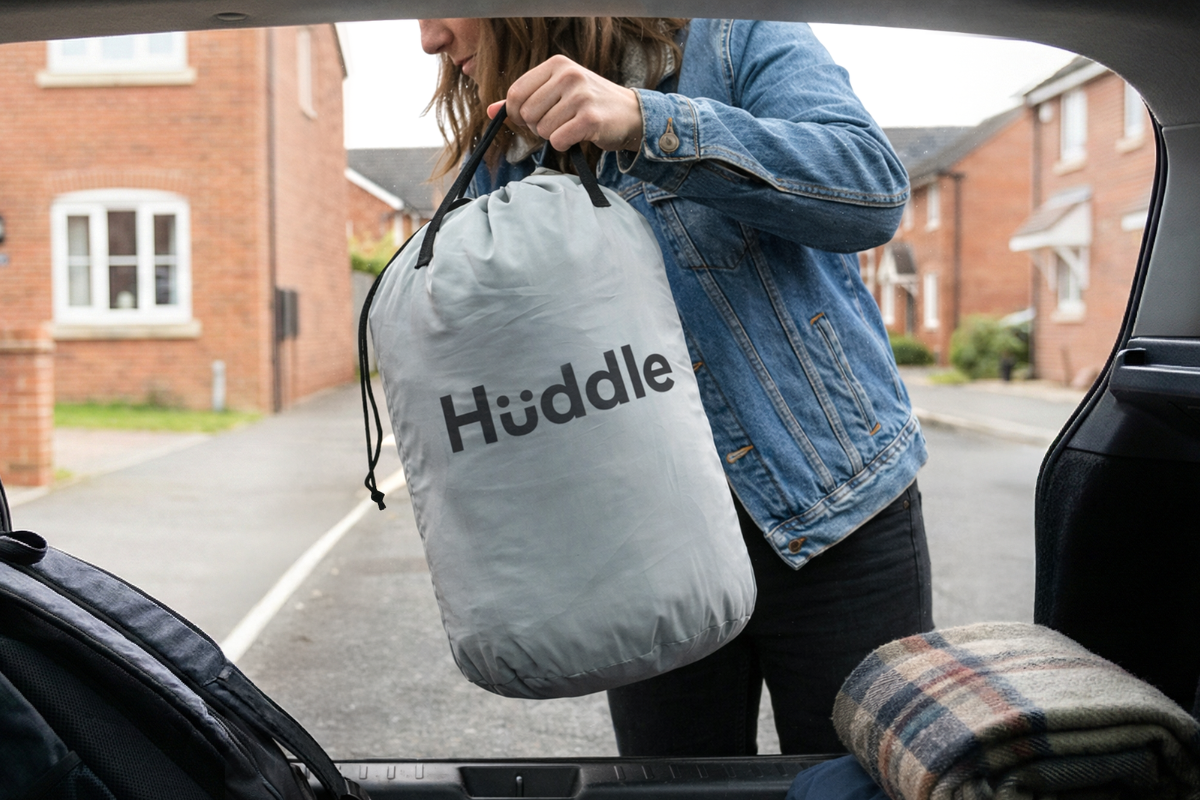
- A carry bag for storage and transport
These features are particularly useful when a temporary sleeping area needs to function like a proper guest setup rather than simply somewhere to lie down.
You can check the Huddle FAQs for more information about setup, power and product use.
How to Choose the Right Airbed Size for a Small Room
Choosing the largest mattress that fits through the door is rarely the best approach.
You need usable space around the bed as well.
Single Airbed
A single can be the most practical option for one overnight guest, particularly in a compact home office, child's room or narrow spare room.
It leaves more usable floor space and is easier to position without blocking cupboards and doors.
Double Airbed
A double is often a useful middle ground for couples or a solo guest who appreciates additional room.
Before choosing one, measure the room with the bed fully deployed and check that you can still access the doorway and essential furniture.
King and Larger Sizes
A larger airbed can provide more sleeping space when the room allows it, but small-space practicality should come first.
A generous mattress is less useful if guests have to climb over it to leave the room.
A Simple Measuring Rule
Before buying, mark the proposed mattress footprint on the floor using masking tape or everyday objects.
Then check:
- Can the door open normally?
- Can your guest walk down at least one side?
- Can they reach their belongings?
- Can the pump and controls remain accessible?
- Is a mains socket safely reachable if required?
- Does the mattress touch sharp furniture edges?
This simple exercise gives you a much better impression of the real space than looking at dimensions on a screen.
How to Make a Temporary Guest Bed Feel More Considered
The bed itself is only part of the experience.
A guest staying in a living room or office knows that they are sleeping in a temporary space. The aim is not to disguise that fact, but to make the arrangement feel deliberate and comfortable.
Prepare the Bed Before Guests Arrive
Avoid waiting until everyone is tired before opening packaging, looking for pumps or working out how the controls operate.
Set the bed up in advance so you can identify any space, power or bedding problems beforehand.
Use Proper Bedding
Treat the airbed, folding bed or sofa bed as you would a normal guest bed.
Provide:
- A fitted or flat sheet suited to the sleeping surface
- A suitable duvet
- Comfortable pillows
- An extra blanket if needed
- A bedside glass or bottle of water
Give Guests Somewhere for Their Belongings
Even if there is no spare bedroom, clearing a chair, drawer or section of hanging space can make a short stay much easier.
Keep a Route to the Door Clear
This is particularly important when a guest bed is placed in a small living room or office.
Do not fill the entire room simply because the mattress technically fits. Guests should be able to get up and move around comfortably during the night.
Keep Controls and Power Accessible
If you are using an electric airbed, position it so the power connection and controls can be reached without moving furniture or stretching cables across busy walkways.
For more detailed preparation advice, see Huddle's guide to hosting overnight guests without a spare room.
Airbed vs Sofa Bed: Which Is Better for a Small Flat?
If you already need a sofa and regularly host guests, a sofa bed can be an efficient use of one permanent furniture footprint.
If you already have suitable seating and simply need somewhere for occasional visitors to sleep, an airbed generally provides greater flexibility because it can be removed after the visit.
The decision comes down to this:
- Choose a sofa bed if you need permanent seating and want it to double as your guest accommodation.
- Choose an airbed if you want the room completely free of guest furniture most of the time.
Airbed vs Folding Bed: Which Saves More Space?
A folding bed can offer a familiar mattress-and-frame setup, but its storage requirements are considerably different from those of a deflated airbed.
Even folded, the mattress and frame still exist at full physical thickness. They usually need a substantial cupboard, garage, storage room or spare section of a bedroom.
An airbed is therefore usually the stronger choice where stored space is more limited than sleeping space.
A folding bed may be preferable where you have adequate storage and want a permanently attached mattress that requires no inflation.
Do You Really Need a Permanent Spare Bed?
For many smaller homes, dedicating an entire room to a bed that is empty most of the year is difficult to justify.
A home office may be used five days a week. A playroom may be needed every day. A living room is part of normal family life.
The more useful question is often not, “Where can we put a guest bed?” but:
“How can this room become a comfortable bedroom only when we need it?”
That is where temporary guest beds become particularly valuable.
You keep the everyday function of the room and add sleeping capacity only when friends or family stay.
Guest Bed Checklist for Small Homes
Before choosing between an airbed, sofa bed and folding bed, work through this checklist.
- Measure the available sleeping area.
- Measure the storage area as well.
- Decide whether you normally host one person or a couple.
- Consider how frequently guests stay.
- Think about whether visitors stay for one night or several.
- Check whether you need the furniture to serve another purpose.
- Consider how easy the bed is to set up and put away.
- Check the height and accessibility for the people who usually visit.
- For airbeds, consider inflation, firmness and pressure maintenance.
- Make sure the room still has a usable route to the door.
FAQs About Guest Beds for Small Spaces
What Is the Best Guest Bed if I Don't Have a Spare Room?
An airbed is often one of the most practical options because you can convert an existing room into a sleeping area temporarily and store the mattress afterwards.
A sofa bed can also work well if you already need seating in the room.
Are Airbeds Suitable for Adult Guests?
Yes, provided you choose an airbed designed for proper overnight comfort rather than focusing only on the lowest price or smallest possible packed size.
Look at sleeping height, internal support, firmness, ease of setup and how the mattress manages pressure through the night.
Is a Sofa Bed Better Than an Airbed for Guests?
Not automatically.
A sofa bed may be useful when you need a sofa anyway. An airbed is generally more flexible when you want the entire room back after guests leave.
Comfort depends heavily on the individual design in either category.
Is a Folding Bed Better Than an Airbed?
A folding bed removes the need for inflation and provides a physical frame, but it takes up considerably more storage space.
An airbed can be better for homes with limited cupboards or no garage, while a folding bed can work well if storage is not an issue.
What Is the Most Space-Saving Guest Bed?
If you mean the smallest option when it is not being used, a deflatable airbed will usually have the advantage over a sofa bed or framed folding bed.
You should still check the packed size of the exact model before buying.
What Size Guest Bed Should I Buy?
Choose according to both your usual guests and your available room.
A single can be ideal for one person in a compact office or bedroom. A double provides more flexibility for couples, while larger sizes require considerably more clear floor area.
Do not forget to leave usable space around the mattress.
Can I Leave an Airbed Inflated for Several Nights?
Always follow the manufacturer's instructions for the model you own. If using a Huddle air bed, refer to the instruction manual and product guidance for correct setup and operation.
Summary: What Is the Best Guest Bed for Small Spaces?
The best guest bed for small spaces depends on what your home is short of: floor space, storage space or both.
A sofa bed makes sense when you already need a sofa. It provides two functions from one permanent piece of furniture, but you need enough room for it all year and enough clearance to open it.
A folding bed works well if you have adequate storage. It gives guests a raised mattress-and-frame arrangement without installing a permanent bed, but it can be bulky when folded.
An airbed is usually the most flexible choice where space really matters. It can provide a full sleeping surface for guests and then be deflated, packed away and removed from the room entirely.
For occasional visitors, a straightforward airbed may be enough. For regular guests or multi-night family stays, it is worth looking for a model designed around support, sleeping height, easy setup and consistent overnight firmness.
That is where the Huddle Never Deflate™ Air Mattress fits particularly well: built for guests, family stays and temporary sleep setups where you want proper overnight comfort without permanently giving up a room to a bed.
Explore the Huddle Never Deflate™ Air Mattress and choose the size that best fits your room, your guests and the way you use your home.
Teilen:
Why Does My Air Mattress Deflate Overnight? 7 Reasons