

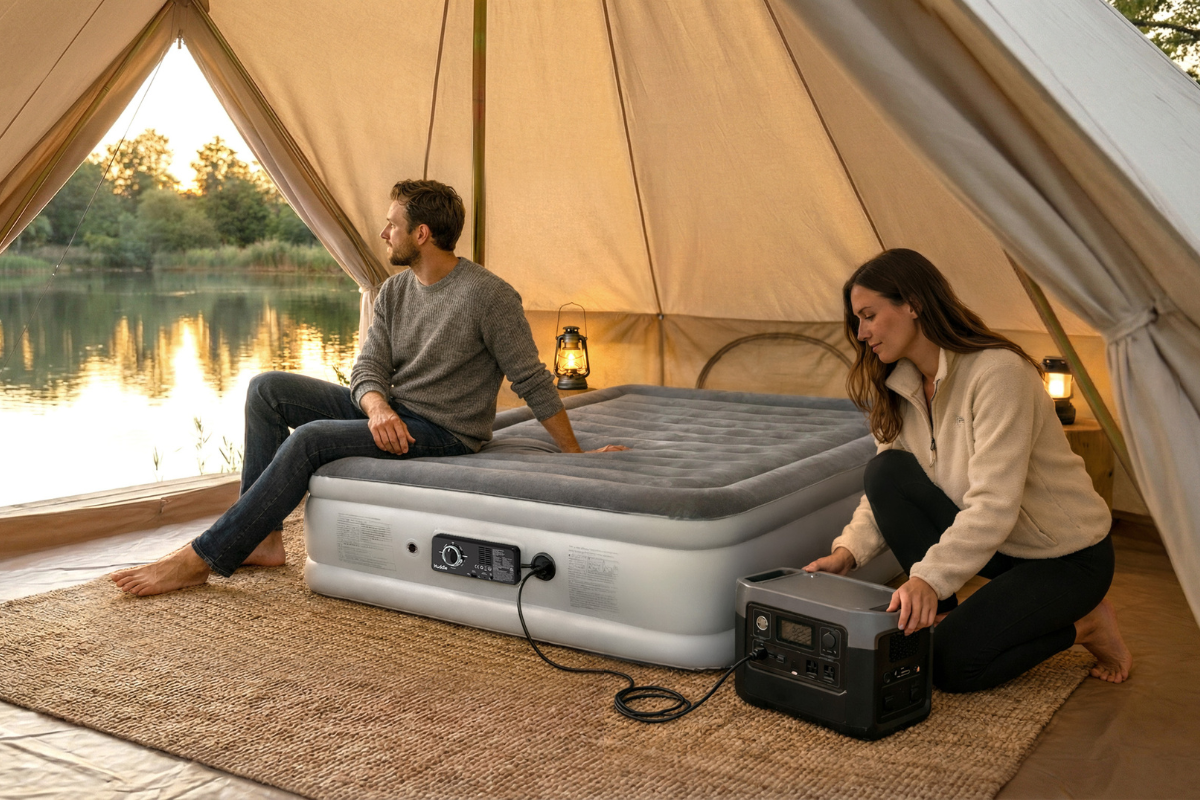
You inflate your air mattress before bed, it feels supportive when you climb in, and then by morning it seems noticeably softer. Naturally, the first question is: why does my air mattress deflate overnight?
A softer air bed does not automatically mean there is a puncture. Changes in temperature, material stretching and small differences in pressure can all alter how an inflatable mattress feels. At other times, a poorly sealed valve, tiny puncture or damaged seam really is allowing air to escape.
Understanding the difference matters. A little settling can be normal. Consistently waking up on a noticeably softer or flatter mattress is a sign that something needs checking.
Here are the seven most common reasons an air mattress loses firmness overnight, how to identify them and what you can do about each one.
Why Does My Air Mattress Deflate Overnight Even Without a Leak?
An air mattress works by containing pressurised air inside a flexible structure. That means its firmness depends on several things working together:
- The amount of air inside the mattress
- The temperature of that air
- How much the mattress material stretches
- The quality of the valve and seams
- Whether the mattress has been damaged
- The pressure created when somebody lies on it
- Whether the bed can compensate for pressure changes during the night
This is why an air bed can sometimes feel softer without actually having a hole.
Before reaching for a puncture repair kit, consider each of the following causes.
1. Temperature Changes Can Reduce Air Pressure
One of the most easily overlooked reasons for an air mattress losing air overnight is a drop in temperature.
The air inside your mattress responds to the temperature around it. When the room becomes cooler overnight, the air inside contracts. The mattress may therefore feel slightly softer even though the air has not escaped.
This can be particularly noticeable when an air bed is used:
- In a conservatory or garden room
- On a cold bedroom floor
- In a tent
- During autumn or winter camping
- Near an open window
- In a room where the heating switches off overnight
Does Cold Air Actually Make an Air Mattress Deflate?
Not necessarily.
The mattress may simply have lower internal pressure because the air has cooled. Once the surrounding temperature rises again, the pressure may change too.
A small overnight difference is therefore not always evidence of a leak.
However, if the mattress becomes dramatically flatter or continues losing firmness regardless of temperature, it is worth checking the other causes below.
2. A New Air Mattress Can Stretch During Its First Few Uses
A new inflatable mattress can sometimes feel as though it has lost air shortly after being set up.
In reality, the material itself may be stretching.
Flexible air bed materials need to accommodate the internal air pressure as well as the weight of the people using the mattress. During the first few inflation cycles, the outer structure can settle and expand slightly.
That additional internal space can make the mattress feel softer even if very little air has escaped.
What Should You Do With a New Air Mattress?
If the manufacturer's instructions allow it:
- Inflate the mattress according to the recommended setup procedure.
- Allow the material to settle.
- Check the firmness again before sleeping.
- Make a small adjustment if needed.
- Repeat the process over the first few uses if the material continues settling.
Avoid assuming that a new air bed has a puncture simply because it feels slightly softer after its first night.
Huddle owners can follow the air bed set-up guidance or check the instruction manuals before first use.
3. The Valve May Not Be Completely Sealed
If your air mattress keeps deflating, the valve is one of the first places to inspect.
The valve creates the seal that keeps pressurised air inside the mattress. If it is slightly open, incorrectly positioned or obstructed, air may escape slowly over several hours.
The mattress could still appear completely inflated at bedtime but become noticeably softer by morning.
How to Check an Air Mattress Valve
Check that:
- The valve is fully closed.
- Any valve cap sits correctly.
- Nothing is trapped around the seal.
- There is no obvious cracking or distortion.
- The surrounding material has not been pulled or damaged.
- Built-in pump controls are positioned as specified by the manufacturer.
Always follow the instructions for your particular mattress because valve systems differ between models.
A poorly sealed valve is often easier to solve than a puncture, so it is worth checking before inspecting the entire mattress.
4. A Tiny Puncture Can Create a Slow Leak
Not every puncture produces an obvious rush of escaping air.
Very small holes can cause a gradual air mattress slow leak, allowing enough air to escape over several hours that the bed feels significantly softer in the morning.
Common sources of punctures include:
- Sharp objects on the floor
- Pet claws
- Rough surfaces
- Furniture edges
- Small stones when camping
- Dragging the mattress while inflated
- Storage alongside tools or other sharp objects
Signs You May Have a Slow Leak
A genuine slow leak becomes more likely if:
- The mattress loses a similar amount of firmness every night.
- The problem continues even in a room with a stable temperature.
- Adding air provides only temporary improvement.
- One area of the bed appears to sink more than another.
- You can hear or locate escaping air near a particular area.
Inspect the mattress carefully rather than repeatedly overinflating it to compensate.
If a repair is required, use the method recommended by the manufacturer. If you own a Huddle air bed and are unsure what to do next, the Huddle support team can help you identify the appropriate next step.
5. Seams Can Deteriorate or Become Damaged
The seams of an inflatable mattress have an important job. They join sections of flexible material that need to contain pressurised air while supporting the sleeper's weight.
If a seam becomes weakened, separated or damaged, it can create another form of slow leak.
Seam problems may develop because of:
- Long-term wear
- Repeated folding in the same place
- Incorrect storage
- Excessive inflation
- Pulling or dragging the bed while inflated
- Damage during transport
- Excessive pressure on a small section of the mattress
Why Seam Leaks Can Be Difficult to Spot
A seam leak may be extremely small.
Unlike a large puncture in the sleeping surface, it can be hidden along an edge or around part of the structure. The result may simply be a mattress that gradually sinks throughout the night.
If you suspect structural or seam damage and your air bed may still be covered by warranty, contact the manufacturer before carrying out a permanent repair.
Huddle owners can also register their warranty and use the brand's support resources for further guidance.
6. Overinflation Can Put Unnecessary Stress on the Mattress
It is easy to assume that an air mattress should be inflated as firmly as physically possible.
That is not necessarily better.
When an air bed is already highly inflated, adding the weight of one or two sleepers increases the pressure inside it further. Repeatedly putting excessive pressure on the mattress can place unnecessary strain on its seams, valves and surrounding material.
Instead, aim for the firmness recommended by the manufacturer.
More Air Does Not Always Mean More Support
A properly designed air mattress should feel supportive without needing to be stretched to its limit.
If you routinely add more air every evening because the mattress feels soft by morning, investigate why the pressure is changing rather than automatically inflating it harder each time.
Better habits include:
- Follow the recommended inflation process.
- Avoid treating maximum firmness as the default.
- Let a newly inflated mattress settle.
- Keep the mattress on a flat, clear surface.
- Never jump or deliberately bounce on it.
- Check the manufacturer's guidance before topping it up.
For model-specific guidance, Huddle owners can also check the Huddle FAQs.
7. Ordinary Air Beds Do Not Actively Maintain Their Pressure
This is the part that explains why an air mattress can behave differently from a conventional mattress even when nothing is technically broken.
A traditional air bed is essentially a sealed reservoir of air.
You inflate it to a particular pressure, close the valve and then rely on that original volume of air for the entire night.
It cannot react when circumstances change.
If the air cools, the material stretches or the internal pressure changes when you lie down, an ordinary air mattress does not automatically add more air.
That means you might start the night with one level of firmness and wake up with another.
For occasional use, a minor change may not matter. But if you want a guest bed that feels consistently supportive from bedtime until morning, pressure maintenance becomes a much more important feature.
Common Air Mattress Problems and What They Usually Mean
| What You Notice | Possible Cause | What to Check |
|---|---|---|
| Slightly softer in a cold room | Temperature-related pressure change | Room temperature and firmness later in the day |
| New bed feels softer after first inflation | Material stretching | Allow it to settle and follow setup guidance |
| Gradual loss of air every night | Valve or small puncture | Valve seal and mattress surface |
| One side sinks more noticeably | Local puncture or structural issue | Surface, seams and surrounding area |
| Air escapes near the pump or valve | Valve or seal problem | Valve position and condition |
| Mattress feels excessively tight | Possible overinflation | Manufacturer's recommended setup |
| Firmness changes even without obvious damage | Normal pressure variation | Whether the bed actively maintains pressure |
How Can You Tell Whether Your Air Mattress Is Actually Leaking?
The key is consistency.
Temperature changes and initial material stretching tend to produce limited changes in firmness. A genuine leak will normally continue reducing pressure until more air is added.
Try This Overnight Air Mattress Check
- Set the mattress up in a room with a reasonably stable temperature.
- Inspect the floor for sharp objects before inflation.
- Inflate the bed normally rather than excessively.
- Check that every valve is fully sealed.
- Leave the mattress unused for several hours.
- Compare its firmness before and afterwards.
- Repeat the test with somebody sleeping on it if necessary.
If it remains firm while empty but becomes much softer under normal use, look carefully at seams, valves and any areas exposed to additional strain.
If it loses substantial pressure even while unused, a leak becomes more likely.
How to Stop an Air Mattress Deflating Overnight
You cannot prevent every pressure change in a conventional air bed, but good setup and care can make a significant difference.
Before Use
- Choose a clean, level surface.
- Remove stones, toys and other sharp items.
- Leave enough space around the mattress so it does not rub against furniture.
- Keep the valve and controls accessible.
- Check access to mains power if using an electric air bed.
- Inflate according to the manufacturer's instructions.
During Use
- Use suitable bedding rather than placing sharp or rigid objects on the bed.
- Avoid sitting heavily on one small edge repeatedly.
- Do not jump on the mattress.
- Keep pets with sharp claws away where practical.
- Avoid unnecessary overinflation.
After Use
- Deflate the mattress correctly.
- Make sure it is clean and dry before storage.
- Fold or roll it according to its instructions.
- Keep it away from sharp objects.
- Store it somewhere protected from excessive heat, damp and physical damage.
Good care matters whether an air bed is used for weekend guests, family visits, children's sleepovers, camping trips, festivals, house moves or temporary sleeping arrangements during renovations.
What If Your Airbed Could Automatically Maintain Its Firmness?
Most of the fixes above deal with leaks, damage and correct setup.
But there is another question worth asking:
What if the air bed could respond when its internal pressure changed?
That is the idea behind Huddle's Never Deflate™ system.
Rather than relying solely on the air added during the initial inflation, the Huddle Never Deflate™ Air Mattress with Patented Dual Pump uses a dual-pump system designed to inflate the mattress and help maintain its pressure.
In practical terms, it is designed to help solve one of the most common air bed frustrations: gradual loss of firmness overnight.
How Huddle Never Deflate™ Technology Works
Pump 1: Inflate the Bed
The primary integrated pump handles the initial inflation of the mattress, helping make setup straightforward when you need to prepare a bed for guests or temporary overnight use.
Depending on the selected setting, the system also allows the sleeper to choose their preferred level of firmness.
Pump 2: Help Maintain the Pressure
The secondary pump is designed to monitor and maintain the mattress pressure by making small adjustments when required.
This is an important difference from an ordinary air mattress.
A conventional design waits for you to notice that the bed has softened and manually add more air. Never Deflate™ technology is designed to respond to pressure changes automatically while the system is connected and operating as intended.
The aim is a more consistent sleeping surface throughout the night, rather than simply a mattress that feels firm when first inflated.
Beyond Pressure: What Else Matters in a Better Air Bed?
Pressure maintenance can be useful, but it should not be the only factor you consider when choosing an air mattress.
A better overnight setup should also consider:
- Support structure: how the internal construction distributes weight.
- Sleeping height: particularly useful for adults getting into and out of bed.
- Surface material: including how comfortably bedding sits on the mattress.
- Firmness adjustment: useful when different guests have different preferences.
- Inflation method: electric inflation is convenient at home, while manual inflation options can provide added flexibility.
- Storage: the mattress should be practical to pack away between uses.
- Support after purchase: clear setup instructions, warranty information and accessible customer support all matter.
Huddle's Never Deflate™ Air Mattress is designed around practical overnight comfort, combining its dual-pump pressure-maintenance system with features intended to make guest stays and temporary sleeping arrangements easier.
These include internal support beams, a double-height design, a flocked sleeping surface, firmness settings, a manual inflation valve, an integrated nightlight, USB-C charging and a carry bag where applicable to the current model.
For the latest specifications and available sizes, see the Huddle Never Deflate™ Air Mattress product page.
Standard Air Bed vs Huddle Never Deflate™ Air Bed
| Feature | Standard Air Bed | Huddle Never Deflate™ Air Bed |
|---|---|---|
| Initial inflation | Manual or electric | Manual or electric |
| Responds to overnight pressure changes | No | Designed to respond |
| May require manual top-ups | Yes | Reduced need while active pressure maintenance is operating |
| Suitable for occasional guests | Yes | Yes |
| Useful for repeated overnight stays | Depends on the design | Particularly useful |
| Needs power for active pressure maintenance | Not applicable | Yes |
| Firmness options | Model dependent | Available on Huddle Never Deflate™ |
Neither type is automatically right for everyone.
If you regularly host family, need a temporary bed during a house move, want a more considered sleep setup for guests or simply dislike waking up on an air bed that feels softer than when you went to sleep, active pressure maintenance becomes much more valuable.
When Is an Air Bed That Maintains Its Firmness Particularly Useful?
Regular Overnight Guests
If parents, adult children or friends stay regularly, consistency matters more than it does for a one-off emergency bed.
A guest sleeping setup should be easy to prepare and designed to remain supportive without unnecessary adjustment during the night.
Smaller Homes
A permanent spare bed is not realistic in every home.
A well-designed air bed can turn a living room, office or multi-purpose room into a sleeping area when needed, then be stored away afterwards.
Family Visits and Bank Holiday Weekends
Multi-night stays expose weaknesses that may be less noticeable after a single evening.
A mattress that repeatedly needs adjusting can quickly become inconvenient when relatives are staying for several nights.
House Moves and Renovations
Temporary sleeping arrangements are sometimes needed for longer than expected.
In these situations, simple setup, reliable support and consistent firmness can become particularly useful.
Camping With Suitable Power
Temperature changes can be more noticeable when sleeping outdoors, particularly as conditions cool overnight.
An air bed can provide a more comfortable sleeping surface for suitable camping setups, but always check the manufacturer's power, setup and usage guidance before travelling.
FAQs About Air Mattresses Losing Air Overnight
Is It Normal for an Air Mattress to Lose Some Firmness Overnight?
A slight difference can be normal.
Cooling air and stretching materials can both make a mattress feel softer without indicating a serious leak.
Large or repeated losses of pressure deserve further investigation.
Why Does My Air Mattress Go Down but Have No Hole?
Possible explanations include:
- Lower overnight temperatures
- New material stretching
- A valve that is not completely sealed
- A very small puncture that is difficult to see
- A seam leak
- Normal changes in internal pressure
A visible hole is only one possible cause.
Can You Overinflate an Air Mattress?
Yes. Adding excessive air can place greater pressure on the mattress once somebody lies on it.
Follow the manufacturer's inflation guidance rather than assuming harder is always better.
Why Does My Air Mattress Deflate More When Someone Sleeps on It?
A person's weight increases pressure within the mattress and places greater load on its structure.
If there is a small leak, valve problem or weakened seam, that additional pressure may make air loss more noticeable.
There is also an important difference between actual air loss and simply feeling the mattress compress under body weight.
Should I Inflate My Air Mattress Again During the Night?
If a conventional mattress has softened, you may need to adjust it.
However, frequently needing to reinflate the bed suggests it is worth checking the valve, surface, seams and overall condition.
A pressure-maintaining air bed takes a different approach by making small adjustments automatically rather than waiting for the sleeper to notice a change.
How Can I Make My Air Mattress Last Longer?
- Keep it away from sharp surfaces.
- Do not drag it while inflated.
- Avoid overinflating it.
- Keep the valve clean.
- Follow the manufacturer's deflation instructions.
- Store the bed clean and dry.
- Use its carry bag where supplied.
- Check the instructions before attempting repairs.
Summary: Why Does My Air Mattress Deflate Overnight?
If you are wondering why does my air mattress deflate overnight, do not immediately assume the bed has failed.
The seven most common explanations are:
- Temperature changes causing internal air pressure to fall.
- New material stretching during the first few uses.
- A valve that is not fully sealed.
- Tiny punctures creating slow leaks.
- Damaged or deteriorating seams.
- Overinflation placing unnecessary stress on the mattress.
- The basic design of standard air beds, which cannot automatically compensate when pressure changes.
Start by checking the simple things: room temperature, initial material settling, valves, the sleeping surface and correct inflation.
If the mattress continues losing substantial firmness, investigate it as a possible leak or structural problem rather than repeatedly adding more air.
And if overnight firmness is one of your main concerns when choosing a new guest bed, look beyond inflation speed alone. A mattress designed to actively maintain pressure addresses the issue differently from a conventional air bed.
Huddle's Never Deflate™ dual-pump system is designed around exactly that problem: providing a practical air bed for guests, family stays, temporary sleeping arrangements and suitable camping setups while helping maintain a more consistent level of firmness through the night.
Explore the Huddle Never Deflate™ Air Mattress and choose the size that best fits your home, guest setup or next trip.
Compartir:
Cómo recibir invitados durante la noche sin una habitación libre en casa
The Best Guest Bed for Small Spaces: Airbeds, Sofa Beds & Folding Beds Compared